Blog
Apollo 13 – a successful failure
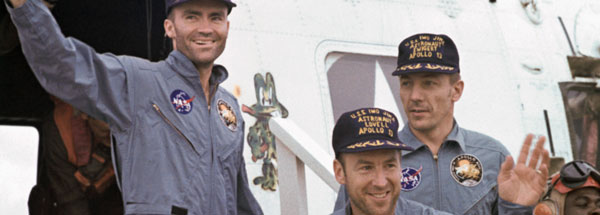
Anyone who spent their holidays 40 years ago on the Pacific Island of Fiji, could see a very peculiar falling star. It was the landing module Apollo 13.
Apollo 13 mission was nicknamed a „succesful failure”. It’s main goal was to land on the moon, but it never happened because of a very serious breakdown. However, the rescue mission was a spectacular success.
“Houston, we’ve got a problem“
When Apollo was leaving the earthly atmosphere, one of the oxygen tanks was damaged. Right after the explosion, the famous words were said: “Houston, we’ve got a problem.”
This message motiveted the entire team in the base to do everything to save the three astronauts: James A. Lovell- the captain, John L.”Jack” Swigert – the pilot of the command module, and Fred W. Haise, the pilot of the lunar module.
Without the oxygen tank, the Odyssey main moduledidn’t have sufficient energy. So it was decided to switch it off immediately, and the crew was to move to the Aquarius module, which was supposed to land on the moon. And then they had another problem: the lunar module had enough oxygen to keep two people alive for two days; and definitely not enough to sustain three people for four days. The carbon dioxide they exhaled was soon to poison the astronauts.
Searching for a solution
This was the main problems that NASA engineers had to solve. The ground team quickly gathered all objects the astronauts had on their ship and started experimenting in order to build a life-saving device. It was a race against time. Finally, by connecting a tube, piece of cardboard and a scotch tape, they managed to constructed a filter that with lithium hydroxide cleaned the air of CO2. This prototype was tested in a special chamber, and when they were sure it worked, they dictated the instruction to the astronauts. After an hour, astronauts confirmed that the “mailbox” (this is how they called the filter) works.
But it wasn’t the end of Apollo’s 13 troubles. The Aquarius module wasn’t designed for space travel, only for landing on the moon. So they had to adjust it to navigating and maneuvering in new conditions.
Odyssey’s navigation system was incompatible with Aquarius. What’s more, navigation was even more difficult as the explosion left them surrounded with debris and gases. Usually, as a point of reference a pilot would use a star that’s far away. But this time, they had to use the only star they could see – the sun. The ground crew quickly developed new navigation protocols. And it all ended well.
Return to earth
Thanks to the cooperation of the ground crew and the astronauts they were able to change the trajectory of Apollo’s flight. It circulated the moon and started returning to Earth. On April 17, after detaching Odyssey and Aquarius, the astronauts landed safely in the Pacific Ocean, and were rescued by an aircraft carrier. Starved, dehydrated and exhausted by stress they could finally put their feet on the ground. They would’ve never done it of it wasn’t for the marvelous cooperation and a series of quick, brilliant decisions made by everyone.
Soon after the rescue mission, the Aquarius producer as a prank sent an invoice to the producer of Odyssey for the towing in space, with 2% off it they paid in cash…
What saved Apollo 13?
Division of tasks
All astronauts knew exactly what their job was. Each of them did it well, and knew his colleagues would do the same.
Communication
Engineers who designed the filtering device knew that it will have to be replicated in space, and in order to do it, they’ll have to understand how it works. This is why communication was crucial. They all had to understand each other, as there was no time for mistakes.
Setting goals
Quick decision of changing the objective from „exploring the moon” to „safely getting 3 men back to Earth” led to success of this operation.
Thinking out of the box
In this case it was using things in extraordinary ways: turning Aquarius into the main ship, building a carbon dioxide filter out of random objects, navigating using the sun as a reference point. If the crew members hadn’t used those ideas, they would have no chances of survival.
Prototyping
All solutions were analyzed and tested thoroughly. If there were simulators available, the earth crew would test new procedures, untypical engine works, new maneouvers, etc. This way the Apollo team could trust their solutions completely.
